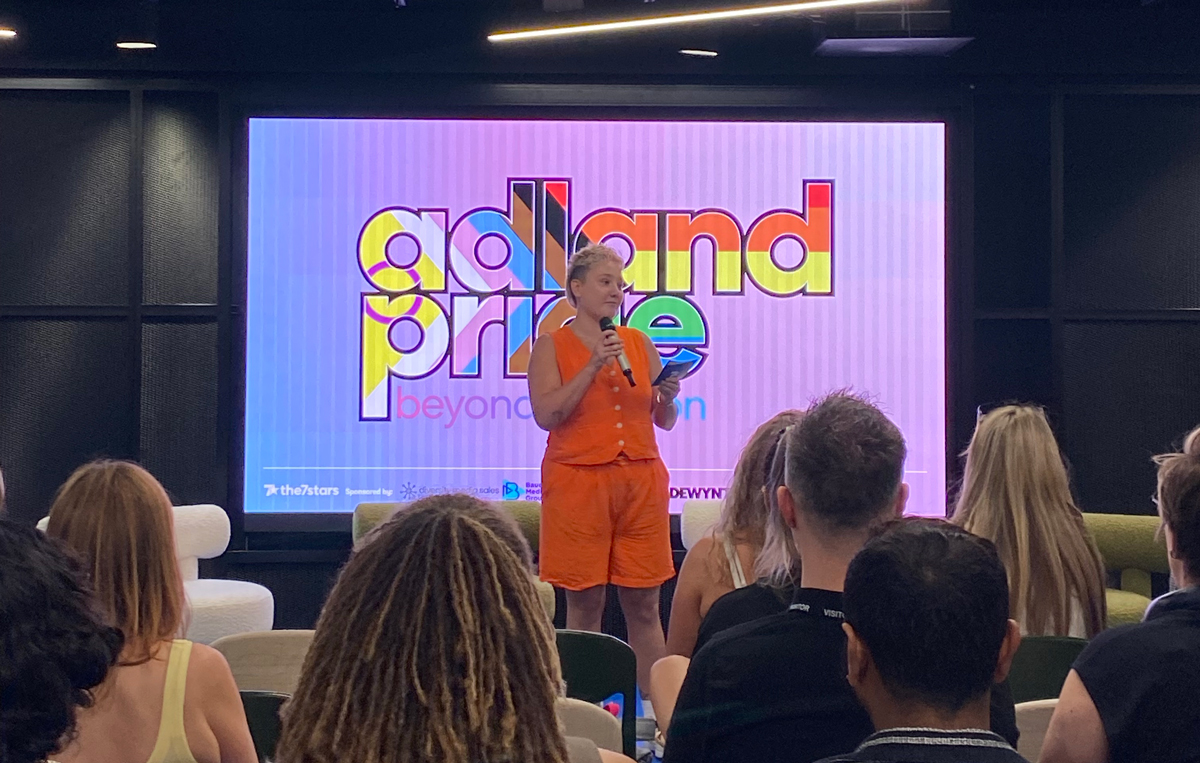
Last week, The Independent joined a roster of industry sponsors for the7stars’ AdLand Pride 2026 in Covent Garden, raising funds for trans+ charity Not a Phase. Newsworks’ summer intern Shelbi Owen reports on her biggest takeaways for an evening of advocacy, queer joy, and industry conversation
As social and political pressure mounts against queer advocacy, bravery is getting quieter. Fruity ‘Alan Carr’ cocktails in hand, the panellists at AdLand Pride grapple with what separates real risk from a rally for an industry and a society that takes queer advocacy seriously — what needs to happen beyond attempts at inclusion. And it starts with the people in this very room.
Now in its second year, the7stars’ AdLand Pride has doubled its attendance to 101 guests from agencies and media owners across the industry, raising funds for Not a Phase, a charity supporting trans+ adults in the UK. Host Imy Brighty-Potts, the7stars marketing and content exec, describes adland as “a beautifully queer, creative, and vibrant place to be” and, in the same breath, “a desperately silly place to be”.
Marty Davies, founder of Trans+ History Week, opens with six learnings from her years in activism — work that has reached Deloitte, Campaign, and earlier this month the floor of UK Parliament, where she delivered a speech at Trans+ History Week’s first parliamentary reception. From ‘be more delusional’ to ‘model a better way’ and ‘do it together,’ Davies’ learnings are cumulative — each one asks more of the room than the last, until the ask lands on the industry itself: “Accountability among trade press.”
The ask of what, exactly, is where the evening gets specific. When asked how performative the rainbow logo change really is, Son Pham of Manifest argues that authenticity comes from “uplifting everybody, like changing policy for employees in the workplace”, rather than showing support only when it’s fashionable. Mair Howells of Dogs & Dykes offers the cleaner version of the same thought: “The best campaigns I’ve ever seen have seemed so obvious.”
Obvious, but not simple. Claire Harvey, psychologist and founder of Not in Our Name — a women-in-support-of-the-trans+-community initiative that gathered 107,000 signatures in under a year — argues that inclusion is a design problem, not an open door. “We used to manage diversity […] You don’t design it and then say, ‘Hi […], Why don’t you come into this?’ You co-design it with all communities. And so you create an environment where people feel safe. Physically and psychologically.” On why organisations resist change even when they intend otherwise, she states: “Nothing in our organisational psyche is designed to be uncomfortable. What we’ve always done feels safe.”
This is where the evening’s sharpest thinking lives. Rhammel Afflick, founder of Queer Beyond Belief, urges the room to treat intersectionality as practice. The term, developed by scholar Kimberlé Crenshaw and widely adopted around 2013, has been co-opted often enough that its meaning has begun to drift. The substance, he says, is simpler and harder than the jargon suggests: “Inclusion in 2026 is […] trying not to think about things in isolation.” The baseline is “acknowledging power.”
Harvey makes this ask of advertising direct. The systemic drivers shaping the experiences of women, trans people, and people of colour are not separate struggles that occasionally overlap: “Unless we tie that together in people’s minds and feelings, we’re always going to be divided.” She calls on the industry to use creative work to connect those strands rather than run each as its own isolated campaign.
Dani St James, founder of Not A Phase, similarly critiques the industry’s tunnel vision: ”We were making progress, opening doors — but actually we were just making profit. The flag was raised when it was profitable. Now there are no flags left.”
The event, St James was clear, is not meant to end at 8:30; it’s meant to travel. Rather than another Pride Month event, AdLand Pride is one “talking point to the people who love you,” something that can be raised at the pub to your uncle. Afflick knows what that looks like in practice; his Jamaican nan disapproved of his bisexuality, but she still told him, “Don’t let those people run you into the ground.”
The conversation does not require agreement to begin. It only requires the conversation. For an industry whose entire business is reaching people, that is not a small brief.