
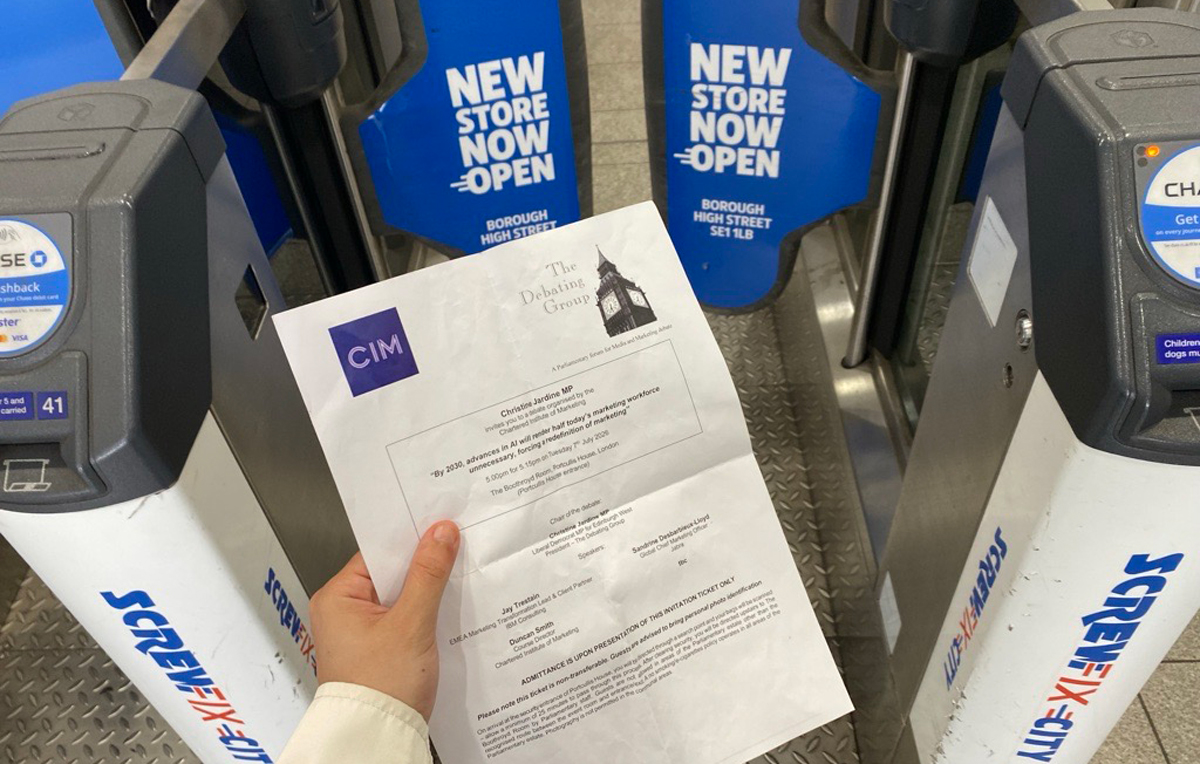
On Tuesday 7 July, The Debating Group returned to Portcullis House’s Boothroyd Room to argue the motion: “By 2030, advances in AI will render half today’s marketing workforce unnecessary, forcing a redefinition of marketing.” Newsworks’ summer intern Shelbi Owen reports on an evening that opened fairly balanced and closed with the room decisively against
The opposing speakers dismissed the motion’s first clause early. Sandrine Desbarbieux-Lloyd, global chief marketing officer at Jabra, called out the flaw directly — “It confuses greater productivity with human redundancy” — while a floor speaker from an AI company added the economic case: universal AI tooling still costs more than paying people. Another pointed to his grandfather’s 50 years at a Vauxhall plant, which shed most of its 10,000 jobs across five decades, not three and a half years; a third sealed it with the World Economic Forum’s estimate of 78 million net new jobs globally.
Recently, the news industry has backed this case in practice — the Guardian’s transformation project has recently created 55 jobs globally — while even one floor speaker, leaning towards the motion, expected any drop in headcount to be followed by a rehire. The real fight, she argued, is between social media channels, not against AI.
Surprisingly, the proposition and opposition agreed more than the motion suggested on the value of human creativity. Jay Trestain, EMEA marketing transformation lead and client partner at IBM Consulting, conceded, “The opposition may say marketing is fundamentally human, and I wholeheartedly agree.” Desbarbieux-Lloyd made the same case, citing Cadbury’s gorilla drumming to Phil Collins as an “irrational” brief no algorithm would have landed on, while one floor speaker agreed that “human beings are really irrational.” We need people who can resonate with people.
It was the second clause — “a redefinition of marketing” — where the real argument sat. Does marketing change or just its tools?
Trestain treated the redefinition as already underway: “The work we currently ask marketers to do is already being rendered obsolete by the way AI is changing how people behave.” Busy, she argued, was never the same as valuable: “It is often just inefficiency with a calendar in mind and an invoice.” Duarte Garrido, co-founder of DoJo AI, framed it as re-skilling: “Everything AI touches becomes the floor,” and the job now is to “break that ceiling” and return to the “out-of-the-box thinking” the marketing profession was promised before it became mostly admin.
The opposition saw new tools, not a new trade. Duncan Smith, course director at the CIM, used Banksy as an example; while he uses aerosol, he is still an artist — just with different tools. Thus, “the tools will change. The trade will not.” Lane made the same point from his own definition of marketing: understanding an audience, shaping an offer, communicating it — none of which AI changes, only how it’s done.
While Desbarbieux-Lloyd didn’t deny that job market turbulence may be part of the picture, Trestain also didn’t dispute the human impact: “AI can replace the mechanics, but not the human reality of need, trust, emotion.” She was mainly for the motion because it made the human contribution matter more.
Nobody disagreed that creativity, judgement and resonance are what’s left once the mechanics are automated. They only disagreed on whether that added up to a redefinition or to marketing doing what it always did, with new tools in hand. If human resonance is the thing left standing, that’s a debate Newsworks — a champion of trusted journalism — has a natural stake in. And the next one to organise.